29 April 2026
HALO Schweiz
A column by Raphaël Membrez
Published in Allnews - April 2026
Until recently, the market valued certain energies as declining assets and technology as an asset in perpetual growth. Yet the context has changed and both assumptions are being put to the test simultaneously, with results whose effects are unprecedented.
Paradigm shift
First of all, the current geopolitical tensions place a premium on energy resources, while innovation accelerates faster than capacity, imposing an additional physical constraint on growth. Driven by deglobalisation and electrification, the investment requirement (capex) is colossal. Furthermore, artificial intelligence (AI) had until now been perceived as a uniform productivity shock, benefiting each company indiscriminately. The launch of "Claude" for the legal sector shook the established leaders on the stock market and illustrates this new paradigm. In this context, then, identifying the players that hold tangible assets protecting against the risk of erosion of competitive advantages due to AI adoption is crucial.
The HALO
effect
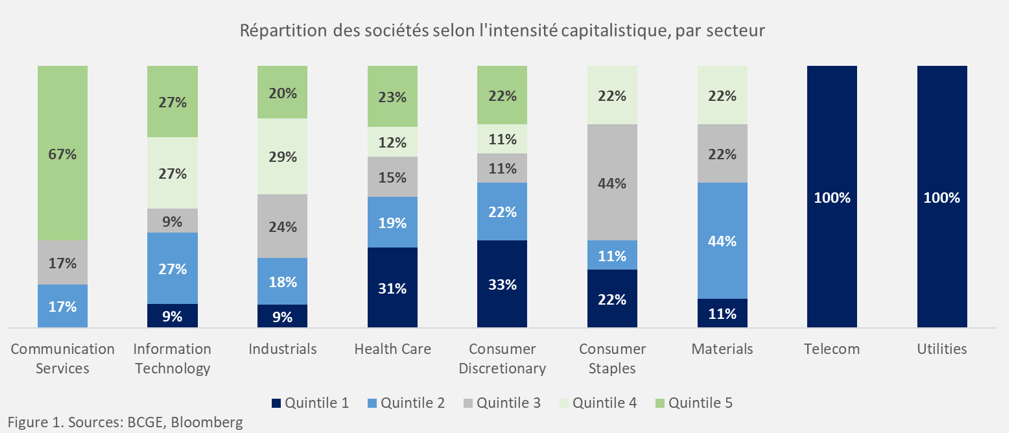
The acronym HALO refers to those companies that hold a substantial base of tangible assets (heavy assets) and whose obsolescence (due to AI) is lower (low obsolescence). This study analyses the Swiss equity market from this angle. The companies of the SPI 1) are classified according to capital-intensity criteria that measure the investment required to maintain production capacity or the share of cash flow absorbed by reinvestment. Each company is classified into five groups, or quintiles. Quintile 1 (q1) corresponds to the 20% most capital-intensive companies (HALO). Conversely, quintile 5 (q5) corresponds to the 20% least capital-intensive companies.
Companies heavily dependent on tangible productive assets (q1 and q2) operate in telecoms, infrastructure and are over-represented in materials and discretionary consumption (figure 1). The healthcare and consumer staples sectors likewise rest on a strong base of tangible assets. Conversely, communication (ex-telecoms) and information technology comprise a majority of "asset-light" companies (q4 and q5), followed by industry, the largest sector in Switzerland and moreover heterogeneous.
Outperformance of tangible assets
Two portfolios were created, one composed of the companies of the first quintile and the other of the fifth quintile. Figure 2 represents the performance difference between these two baskets. The dark-blue area reflects an outperformance, mainly from the 2020s to date, of HALO companies relative to the least capital-intensive companies. Over the start of 2026 to the end of March, the HALO basket shows a relative performance of +4.7% and +2.6% versus the q5 basket and the SPI, respectively.
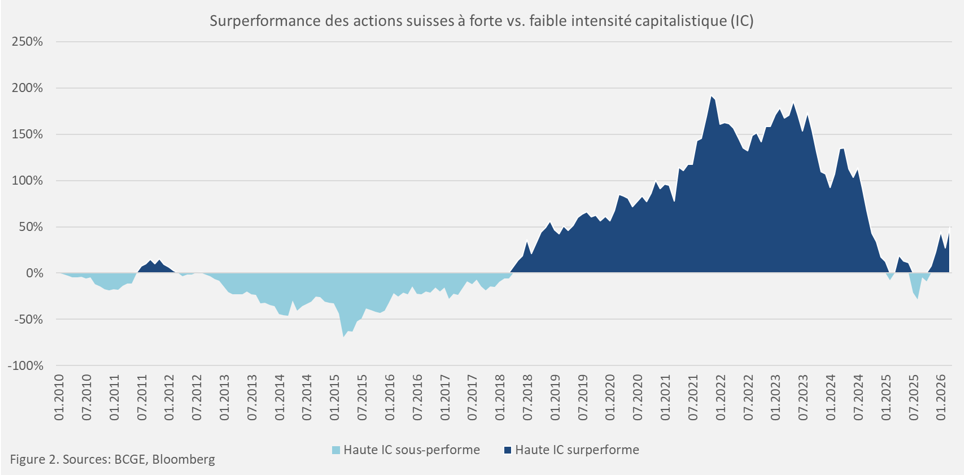
The 2010s were marked by a relative absence of constraints on physical capital, combined with moderate inflation. A low cost of capital linked to low interest rates allowed investors to project themselves over a long-term horizon, favouring the holding of long-duration assets. This preference contributed to an outflow of capital away from tangible assets towards intangible or "asset-light" financial assets. This is reflected in figure 2 by an underperformance of capital-intensive companies between 2010 and 2019.
Rotation towards value companies
This relationship reversed with the post-Covid inflation shock and its effect, exacerbated by the energy crises. Several factors are at play. Demand that runs up against physical capacity constraints, with an economy unable to supply basic goods, coupled with an increased need for capex to support production capacity in a context of re-regionalisation. The sharp rise in interest rates (10-year German Bund) from 2020, in figure 3, reflects this. This regime change is associated with a rebound of so-called value companies, which share similarities with HALO stocks. They are generally more heavily endowed with physical assets, generate cash flows over a shorter term and are less affected by high interest rates.
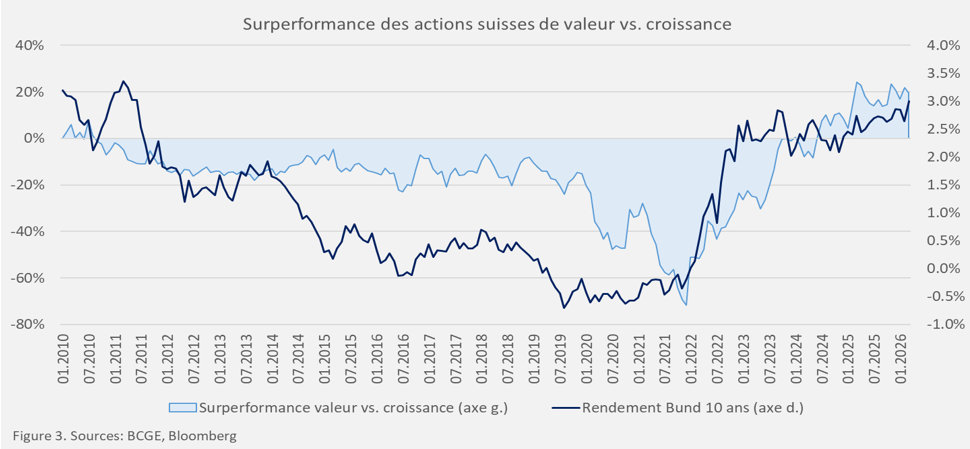
The emergence of AI is not cyclical, but structural. It puts pressure on informational or analytical business models that can be replicated, which promised perpetual recurring revenues. Today the terminal value of these growth models is being called into question. The current paradigm favours disciplined capital allocators, cash-flow generation and the holding of assets whose value creation is controllable.
Business models to favour
Our analysis identifies these levers. They may be network-integrated assets, subject to strong regulation and endowed with portfolios of concessions, such as energy suppliers or telecoms. Ownership of a physical production or distribution network, characteristic of materials and consumer-staples companies, is a differentiator, as is the holding of patents that protect the development of molecules in healthcare and materials. Endowed with a heritage of brands and capitalising on a customer relationship, discretionary and staples consumer players do well. It should be noted that a business model can be sustainable and "asset-light". The barrier and the mission-critical dimension matter more than the heaviness of the assets. This is the case of Galenica, which controls a physical distribution network, Temenos, which develops core infrastructure software embedded in a regulatory framework, or Sika, which holds a network, physical production and patents, or again ABB, which supplies physical energy and automation capacity.
HALO companies well positioned
By devaluing energy and production capacity and concentrating wealth in intangibles, the market has increased the vulnerability of asset portfolios. Since HALO models are present in numerous sectors, selectivity with a view to the durability of the business model is decisive. In this respect, active management, unlike passive management, allows selective participation in the vast deployment of infrastructure and the capitalisation on the dispersion generated by AI.
(1) Swiss Performance Index (excl. finance and real estate)
Raphaël Membrez joined the BCGE Group in 2021 and then Synchrony Asset Management in September 2026. He is a member of the Swiss equity conviction management team, serving as a portfolio manager (co-manager) for Swiss equity conviction funds. Previously, he was an analyst and co-manager of a Swiss equity fund at Landolt & Cie (now ODDO BHF Suisse). He completed an Executive Program at HEC Paris, holds a Master’s degree in Finance from Warwick Business School and a Bachelor’s degree from the University of Fribourg (Magna cum laude), and is a CFA charterholder.