

3 February 2026
Swiss indirect real estate: avoid the volatility trap!
A column by Laurent Clauzet
Published in Allnews - February 2026
Real estate occupies a structural place in the asset allocation of Swiss institutional investors. Over the long term, this asset class is characterised by lower volatility than equities, a partial decorrelation from other asset classes and a relatively stable generation of income. These properties explain its central role in pension portfolios, with Swiss pension funds able to allocate up to 25% of their assets to real estate.
The universe of listed indirect real estate in Switzerland is composed of two distinct segments: real-estate equities and listed real-estate funds. Real-estate equities, grouped within the REAL index, are classic equity securities. They are generally integrated into portfolios according to a classic Mean–Variance framework, the investor being aware of the need to diversify specific risk in order to optimise the risk-adjusted return. Conversely, a markedly different behaviour is observed in the segment of listed real-estate funds. Although they are traded continuously on the Swiss stock exchange, with an order book identical to that of equities, these vehicles are still frequently perceived as quasi-bond instruments. This perception stems in part from a possible confusion between the net asset value (NAV), generally published on an annual basis, and the market price, formed continuously intraday. As these funds are structurally semi-open and, in practice, closed most of the time, their price is determined by supply and demand and departs structurally from the NAV, with average premiums or discounts of the order of 20 to 25% depending on the cycle phase. This perception sometimes leads to an excessive concentration on a limited number of funds, or even regularly on a single vehicle, very significantly increasing the specific risk for the investor.
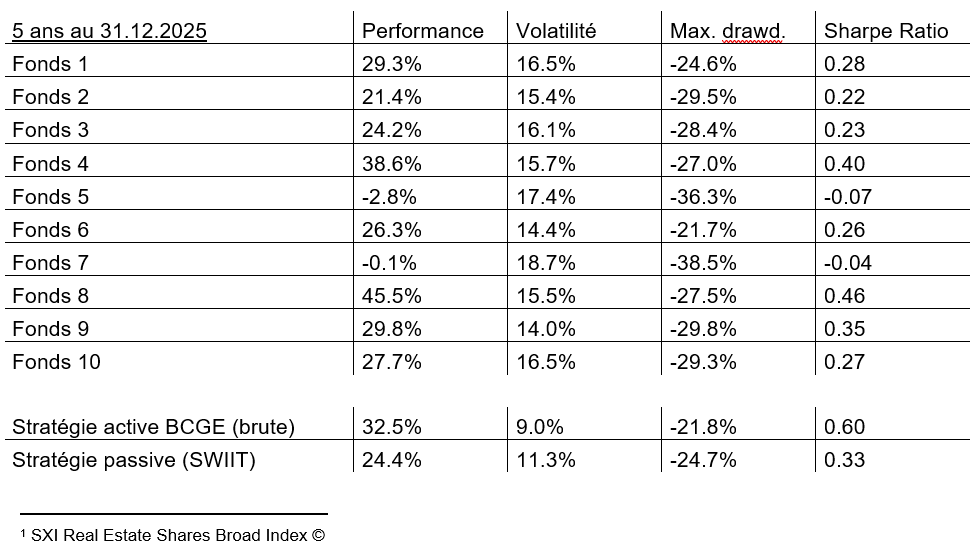
Each listed real-estate fund holds a portfolio of real assets, by definition unique, often concentrated geographically and sectorally. Performance therefore depends heavily on specific factors: quality and location of the property portfolio, financing structure, distribution policy, as well as the manager's decisions. From a quantitative point of view, this concentration translates into significant idiosyncratic volatility, liable to reduce the risk-adjusted return, particularly during phases of tension on the financial markets or of rising interest rates. The table below presents the ten largest market capitalisations of Swiss listed real-estate funds, together with their total performance, their recent volatility and their Sharpe ratio. The gaps observed between the funds are marked, both in terms of return and of risk, which empirically confirms the heterogeneity of the risk/return profiles within this asset class.
Two aggregated strategies are also presented: an active conviction approach combining 25-30 real-estate securities (listed funds and real-estate equities), as well as a passive approach based on the SWIIT index, which groups together all the Swiss listed real-estate funds. In both cases, diversification allows a reduction of the portfolio's standard deviation (volatility) and an improvement of the Sharpe ratio, in line with the predictions of the Mean–Variance framework. Finally, an even broader diversification can be obtained by combining the segment of listed real-estate funds (SWIIT) with that of real-estate equities (REAL). The joint integration of these two segments allows the exploitation of partially distinct sources of risk and an improvement of the efficient frontier of the real-estate allocation.
In conclusion, while Swiss indirect real estate constitutes an essential component of asset allocation, an exposure concentrated on a single listed real-estate fund strongly accentuates the undiversified specific risk. The empirical results argue in favour of a diversified approach, all the more so an active one, in order to maximise the risk-adjusted return and to durably capture the stabilisation properties associated with this asset class.
Laurent Clauzet joined BCGE in 2021. He is a member of the Swiss equities conviction management team and responsible for strategies on high-dividend equities as well as on Swiss indirect real estate. He began his career in 2014 at the multi-family office Fitzroy Investment Advisors, as an equity-fund selection analyst. Then, between 2017 and 2021, he held several positions at Solvalor fund management, a fund management company, and managed several real-estate funds. He holds a Master in Management from EMLyon Business School with a major in Finance and the CFA® designation.