

28 May 2026
The market votes in the short run but it weighs in the long run
A column by Anton Berthot
Published in Allnews - May 2026
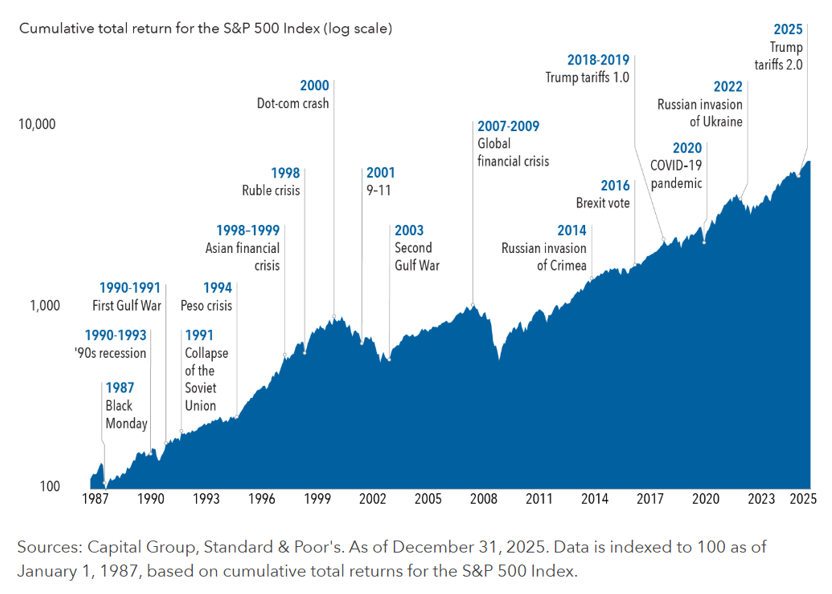
Benjamin Graham's famous adage "In the short run, the market is a voting machine; in the long run, it is a weighing machine" aptly captures one of the great paradoxes of the markets. In the short run, they react like an emotional barometer: they vote, punish or sometimes applaud and extrapolate. But in the long run, they end up weighing companies for what they truly are: their capacity to innovate, to grow, to defend their margins and to generate lasting returns on capital.
This distinction between short-term noise and long-term substance has probably never been as relevant as it is today. Elections, wars, trade tensions or new tariffs: the market environment seems permanently shaken by exogenous shocks. Yet, taking a step back, history shows that equity markets — the American market in particular — have often absorbed these shocks without calling their underlying trajectory into question. Over a long-term horizon of 40 years, US equities (S&P 500) delivered a performance of around 11% annualised in USD, this despite several years of sharp declines (dot-com bubble 2000-2002: -38%, financial crisis 2008: -37%, inflation peak of 2022: -18%). In other words, for the long-term investor, many of these shocks eventually fade and patience is ultimately rewarded.
The noise of conflicts, the resilience of markets
This obviously does not mean that market falls are without consequence for investors. In the short run, events such as armed conflicts can cause significant market declines, particularly when they touch on energy. The current war around the Strait of Hormuz is the perfect example. This narrow passage concentrates around 25% of global oil trade and nearly 20% of the liquefied natural gas transported by sea, according to the International Energy Agency. From this perspective, the conflict in Iran perfectly illustrates this mechanism: the market reacts quickly and violently in the face of immediate uncertainty, but it then reassesses the real consequences on companies' future growth and profits. If history is a good guide to the future, we can then highlight that, on average, the American market is up 8% one year after the start of an armed conflict. One explanation lies in the oil intensity of GDP, which has fallen by nearly 60% since the first oil shocks of the 1970s, according to the World Bank. It is therefore not so much the event itself that determines the long-term trajectory of markets, as its capacity — or not — to durably alter the economic fundamentals.
In the short run, volatility concentrates where the narratives are most powerful
This is particularly true of the most commented themes of the moment. Companies linked to artificial intelligence, and to "data centres" in particular, today concentrate a significant share of stock-market volatility, because they lie at the crossroads of the highest growth expectations, the most demanding valuations and the greatest debates on the sustainability of investment spending.
What the market ultimately weighs: growth, margins, return on capital
Once short-term noise has been put in its rightful place, the central question once again becomes the quality of companies. For, over time, what the market ultimately weighs is neither the headlines nor the emotions, but a company's capacity to create value. The companies that establish themselves over time are often those that combine several attributes: continuous innovation, structural growth, high margins, attractive return on investment and solid barriers to entry. It is precisely here that certain Swiss companies stand out. In a market often perceived as defensive, Switzerland in fact hosts numerous companies capable of creating value over the long term.
Belimo: a leading specialist at the heart of the major structural trends
Belimo is probably one of the most telling examples of patient and methodical Swiss value creation. In 2025, the group achieved CHF 1.12 billion in sales and a profit of CHF 182 million (growing at 8.5% and 12.4% per year respectively over 10 years). The company continues to benefit from major structural trends such as energy efficiency, building renovation and the rise of data centres. As early as 2024, Belimo highlighted the acceleration of demand linked to data centres and the strength of its growth strategy based on urbanisation, climate and digitalisation. Belimo demonstrates that a specialist, a leader in critical components, can build strong barriers to entry such as: technical expertise, quality, reliability, incremental innovation and customer proximity. In the short run, the stock can be sensitive to valuation levels, interest rates or market movements. In the long run, the market will weigh the company's capacity to turn these megatrends into profitable long-term growth. Since the end of July 2025, the stock shows a market performance of -32% as at 31.03.2026 compared with the Swiss market at +8% (Swiss Performance Index or SPI). Over the longer term: +505% over 10 years (6th best performance out of the 200 companies in the SPI, which is up +114%) or +2,172% over 20 years (SPI +189%), the best performance of the entire Swiss market.
The long term as an antidote to noise
Fundamentally, Benjamin Graham's quotation retains all its meaning because it recalls a simple truth: time is often the best revealer of value. Markets vote to the rhythm of emotions, fears and the dominant short-term narratives. They then weigh the facts. Wars, elections or trade tensions will continue to provoke strong moments of volatility. The AI theme will likewise continue to concentrate sharp rotations in the short term. But for the patient investor, the real question remains unchanged: which are the companies capable of emerging from the noise with greater market share, better margins, more growth and reinforced barriers to entry? It is precisely in this long-term reading that a company like Belimo takes on its full meaning. In the short run, the market may vote in a sometimes irrational manner. In the long run, it almost always ends up weighing quality.
Anton Berthot is co-manager of Swiss equities conviction funds at BCGE. Previously, he worked as co-manager of funds on Swiss equities, Swiss real estate and multi-assets at RESCAD SA for 8 years. He also counts a few years as an analyst at HSBC and JP Morgan. He holds a Master in Finance from the University of Neuchâtel, a Bachelor from HEC Lausanne and is a CFA charterholder.